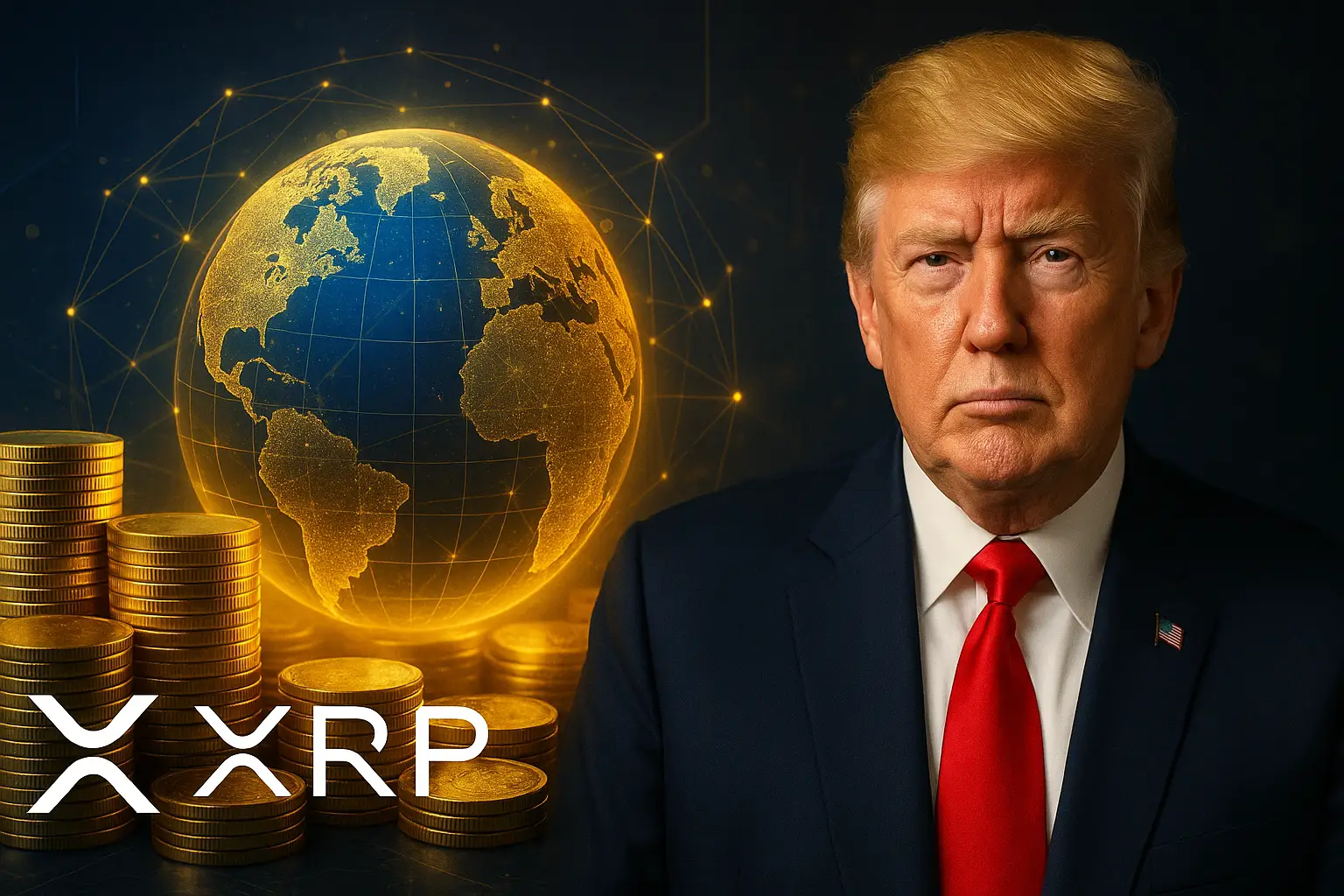
Revised 2026 Edition
Gold is the stock. Oil is the flow. XRP is the bridge. A scenario framework for how sovereign balance sheets, hard assets and programmable settlement systems could be reorganised at global scale.
Boyd Roberts | Big Picture Group | 22 July 2026
Editorial position
Scenario analysis. This paper distinguishes public facts from legal and financial mechanisms, and both from an unconfirmed sovereign-reset hypothesis. It is not financial, legal or investment advice. It does not claim that the United States, Ripple, any central bank or any foreign government has adopted the proposed architecture.
A note on this edition
A theory rebuilt as a testable scenario. This edition preserves the most consequential idea in the original Great Sovereign Reset while retiring its failed 2025 timing model. It separates public fact, possible mechanism and unconfirmed hypothesis, then asks what would have to be true for the architecture to work.
Reading map
| Part One The Proposition |
The failed forecast, objective developments and the sovereign problem. |
| Part Two The Architecture |
Gold, oil, XRP, the sovereign unit and the 10-billion-XRP hypothesis. |
| Part Three The Sovereign Deal |
The global bargain, law, accounting, valuation and execution. |
| Part Four The Test |
Secrecy, access, risks, alternative paths and confirmation standards. |
Executive summary
The revised thesis
Gold is the sovereign balance-sheet anchor. Oil is the real-economy flow. XRP is the bridge-liquidity layer. The official control point is the conversion, collateral and access system built around the public ledger.
The original Great Sovereign Reset began with a simple question: if conventional taxation, austerity and monetary inflation cannot resolve the United States’ sovereign debt problem quickly enough, is there another path?
My answer was that a sovereign balance sheet could be recapitalised by revaluing strategic assets and moving global settlement onto programmable digital rails. In the original thesis, gold was the hard-asset anchor, XRP was the bridge asset, and oil was the real-economy settlement component. I also proposed that Ripple could place 10 billion XRP into a sovereign trust or equivalent US-controlled arrangement, enabling the United States to recognise an enormous new strategic asset alongside revalued gold.
The original paper attached extreme confidence to specific dates in August and September 2025. Those dates passed. The forecast was wrong. The error was not that sovereign asset revaluation is impossible, or that tokenised settlement infrastructure has stopped developing. The error was collapsing possibility, preparedness, political symbolism and timing into one probability estimate. A serious revision must acknowledge that distinction directly.
This 2026 paper therefore removes the date-specific prediction and rebuilds the thesis as a scenario framework. It asks not whether a particular social-media post or market pattern predicts an announcement, but whether the proposed architecture is legally conceivable, financially coherent, technically executable and geopolitically negotiable.
The revised thesis is as follows:
- Gold would operate as the sovereign balance-sheet anchor. The United States could seek to revalue its 261.5 million troy ounces of official gold, either towards market value or to a negotiated official value used within a new reserve arrangement.
- Oil would operate as the real-economy flow. Rather than placing physical barrels into a static basket, participating states could contribute oil-delivery rights, royalties, receivables, reserves or long-term supply commitments.
- XRP would not replace national currencies and would not become everyday money. It would operate as a bridge and liquidity asset connecting sovereign currencies, tokenised deposits, stablecoins, commodities and government securities.
- A separate sovereign reserve and settlement unit could be issued on, or interoperable with, XRPL. That unit — not native XRP itself — could be backed by gold, commodity entitlements and other sovereign collateral.
- A large US XRP inventory would not make the United States a shareholder of Ripple and would not give it ownership of the public XRP Ledger. It could, however, make the United States the dominant sovereign liquidity sponsor, market-maker and conversion-window operator around the official system.
- Access would be controlled through regulated gateways, permissioned domains, approved custodians, sovereign swap lines, official collateral rules and redemption facilities. Countries excluded from the official system could still use a public ledger, but they would not receive the same liquidity, convertibility, collateral recognition or transaction terms.
- The international bargain would have to be negotiated. China, Russia, the United Kingdom, Europe, Japan, India, Gulf producers and other major holders of reserve assets would need an allocation of benefits sufficient to protect or improve their existing claims.
- The operation would be better described as sovereign recapitalisation, monetisation and liability transformation than the literal disappearance of debt. Revaluation may improve the asset side and support a debt exchange, but it does not make counterparties’ claims vanish.
If the United States wanted to create tens of trillions of dollars of gross sovereign asset value within several months, revaluation is one of the only categories of mechanism capable of operating at that speed and scale. That does not prove that the administration intends to do it. It establishes that the mechanism remains theoretically available.
The full gold-oil-XRP reset is therefore a live but unconfirmed scenario. Its defining feature would be strategic surprise. If it had been privately negotiated among major powers, the public might see no XRP-specific evidence until a coordinated announcement. But secrecy cannot become evidence in its own right. The absence of visible proof neither disproves nor confirms the theory.
Part One
The Proposition
Possibility is not prediction. A serious theory must survive its own missed dates.
Chapter 1 — What changed after the 2025 forecast
1.1 The timing model failed
The original model assigned a 99.6 per cent probability to a reset between 26 August and 6 September 2025. That did not occur. Any revised paper that merely moves the dates while preserving the old certainty would repeat the central analytical error.
The failure matters for three reasons.
First, public developments that were interpreted as reset-specific were often consistent with several more ordinary explanations. Digital-asset legislation can advance because an industry needs clear rules. Treasury buybacks can improve market liquidity without rehearsing a monetary reset. Blockchain infrastructure can be adopted incrementally. Political language can be rhetoric rather than operational signalling.
Second, Bayesian language did not make the original estimates Bayesian in a rigorous sense. Likelihood ratios were assigned subjectively, correlated observations were treated as independent, and the base rate for an unprecedented gold-XRP sovereign operation was not given sufficient weight.
Third, the predicted event was not adequately falsifiable. When a theory expects hidden preparation, every lack of evidence can be reinterpreted as successful secrecy. That is logically possible, but it cannot justify increasing confidence.
The correct update
The correct update is neither “the thesis has been disproved” nor “the thesis was right but delayed”. It is more precise:
- The specific 2025 timing prediction was wrong.
- The public evidence did not justify near-certainty.
- The underlying mechanism remains theoretically possible.
- The selection of XRP remains unconfirmed.
- Any future event window must be treated as political context, not a deterministic forecast.
1.2 What has objectively advanced
Several public developments since the original research have strengthened the general digital-finance infrastructure.
| Development | What it established |
|---|---|
| GENIUS Act July 2025 |
A US federal framework for payment stablecoins, including liquid reserve requirements, public reserve disclosures and the technical capacity to freeze or burn stablecoins when lawfully required. The administration explicitly linked the legislation to Treasury demand and continued dollar reserve status. [1] |
| Strategic Bitcoin Reserve March 2025 |
Established by executive order alongside the United States Digital Asset Stockpile. The order selected Bitcoin as the named strategic reserve asset and placed other government-owned digital assets in a separate stockpile. Additional non-Bitcoin stockpile assets could not be acquired outside forfeiture or civil penalties without further executive or legislative action. [2] |
| Fintech integration order May 2026 |
Federal regulators ordered to identify and remove barriers preventing digital assets and fintech firms from integrating with banks, payment systems, custody, brokerage and capital-market services. [3] |
| Digital Asset Market Clarity Act 14 May 2026 |
Advanced from the Senate Banking Committee by a 15-9 vote and moved to the Senate floor. It had not completed the entire legislative process as at this paper’s date, but the vote demonstrated continued movement towards a comprehensive market-structure framework. [4] |
| SEC v. Ripple concluded August 2025 |
Both parties dismissed their appeals. The district court’s final judgment — including the civil penalty and injunction concerning unregistered institutional sales — remained in effect. The conclusion removed a major unresolved appellate process, while not granting Ripple unlimited freedom to conduct institutional XRP distributions. [5] |
| BIS Project Agora June 2026 |
Eight central banks and more than 40 regulated institutions testing elements of a shared cross-border architecture for tokenised central-bank reserves, commercial-bank deposits and government bonds. [6] |
| Ripple RLUSD 16 July 2026 |
A functioning regulated stablecoin with published reserve attestations. Ripple reported approximately US$1.51 billion in circulating RLUSD and US$1.62 billion in reserve funds. [7] |
These facts support the broad proposition that regulated digital settlement infrastructure is becoming more mature. They do not establish that XRP has been privately selected as a sovereign bridge asset or that a gold-oil-XRP reset has been agreed.
Chapter 2 — The sovereign problem the thesis is trying to solve
2.1 Debt is sustainable until confidence or affordability changes
The United States is not a household. It issues debt in a currency its own central bank can create, maintains the deepest sovereign securities market in the world and can refinance obligations over time. It is therefore inaccurate to describe a particular debt total as an automatic insolvency date.
The problem is instead a deteriorating trajectory. The Congressional Budget Office projected a fiscal-year 2026 deficit of approximately US$1.9 trillion, debt held by the public at about 101 per cent of GDP and net interest outlays exceeding US$1 trillion. It described the longer-term fiscal trajectory as unsustainable. [8]
Gross federal debt was approximately US$39.5 trillion in July 2026, while debt held by the public was lower. Those are different measures and should not be used interchangeably. Gross debt is relevant to the dramatic balance-sheet arithmetic in this paper; debt held by the public is often more relevant to market financing and macroeconomic analysis. [9]
The system can continue refinancing for a long period. But conventional remedies operate slowly:
| Remedy | Limitation |
|---|---|
| Tax increases | Improve cash flow but are politically difficult and rarely create tens of trillions of dollars of immediate balance-sheet value. |
| Spending cuts | Can reduce future deficits but may contract demand and cannot erase the existing stock rapidly. |
| Economic growth | Improves debt ratios over time but is not an overnight recapitalisation. |
| Inflation | Reduces the real value of nominal liabilities but transfers wealth from savers and damages credibility. |
| Default or restructuring | Reduces claims directly but can fracture the Treasury market and the dollar system. |
If the political objective were to display a profound improvement in the sovereign asset position within months, an asset revaluation or monetary reconstitution would be one of the few mechanisms fast enough.
2.2 The midterm window is an incentive, not a solvency deadline
The 2026 US midterm elections are scheduled for 3 November. From 22 July, the political window is approximately three and a half months.
That timetable could create an incentive for a dramatic economic announcement. It does not compel one. The Treasury is not required to offset the entire national debt before the election. It can continue issuing and rolling securities. The argument is consequently conditional:
If an administration had decided that it wanted a tens-of-trillions-dollar sovereign recapitalisation before the midterms, revaluation would be one of the only categories of policy capable of delivering the required headline scale.
The uniqueness of a mechanism does not prove that the objective has been chosen.
Part Two
The Architecture
Three assets, three jobs — and a separate sovereign settlement unit around them.
Chapter 3 — The revised three-part architecture
|
GOLD The stock Sovereign collateral and credibility anchor |
OIL The flow Real-economy demand and strategic trade layer |
XRP The bridge Liquidity between currencies, assets and ledgers |
The strongest form of the Sovereign Reset is not XRP replacing fiat currencies. It is a new reserve and settlement architecture in which three different assets perform three different jobs.
3.1 Gold: the stock and credibility anchor
Gold is the asset already held by central banks, recognised across political systems and free from another country’s promise to pay. It is the natural asset for recapitalising the sovereign balance sheet.
The United States Treasury owns approximately 261.5 million troy ounces. At the statutory gold-certificate price of US$42.22 per ounce, that gold has a book value of only about US$11 billion. At different illustrative official valuations:
| Official price per ounce | Implied value of 261.5m oz |
|---|---|
| US$42.22 (current statutory) | ~US$11 billion |
| US$10,000 | ~US$2.615 trillion |
| US$25,000 | ~US$6.54 trillion |
| US$50,000 | ~US$13.08 trillion |
| ~US$151,000 | ~US$39.5 trillion (gold alone) |
The purpose of an official gold price would not necessarily be unlimited retail convertibility. It could instead establish a sovereign collateral reference used for central-bank accounting, intergovernmental settlement, swap facilities and debt-exchange ratios.
The division of labour
Gold gives the proposed system an external credibility anchor. XRP gives it movement. The distinction is essential.
3.2 Oil: the flow and geopolitical utility layer
Oil is not an ideal static reserve asset. It is costly to store, varies by grade and location, and experiences substantial price volatility. But it remains central to industrial production, transport, defence and global trade. The Strait of Hormuz alone carried approximately 20 per cent of global petroleum-liquids consumption in 2024, demonstrating the monetary and strategic importance of energy routes. [10]
The United States also produced a record average of approximately 13.6 million barrels of crude oil per day in 2025. The Trump administration established a National Energy Dominance Council covering energy production, distribution and transportation. [11]
In a sovereign settlement architecture, oil could be represented through:
- forward delivery commitments;
- tokenised warehouse or terminal receipts;
- royalties and export receivables;
- long-duration supply agreements;
- rights over strategic reserves;
- benchmark-linked settlement contracts.
Oil would generate recurring transactional demand. Importers require energy; producers require reliable settlement. A system offering better terms for oil trade would therefore create a practical reason for nations to join beyond speculative interest in a digital asset.
The phrase “control the oil routes” should not be interpreted literally. No single state controls every producer, shipping lane, insurer, port and pipeline. The relevant leverage comes from a combination of production, naval security, sanctions, insurance, clearing, dollar settlement and political agreements.
3.3 XRP: the bridge, not the currency
XRP is the native asset of the public XRP Ledger. Its relevant conceptual role is not to replace dollars, renminbi, pounds, euros or roubles. It is to bridge between them.
The XRP Ledger can represent and exchange issued assets, use pathfinding and decentralised liquidity, and settle transactions rapidly. Ripple describes XRP as an asset that bridges currencies in the ledger’s decentralised exchange. Ripple, XRP and XRPL are nevertheless distinct. [12]
That distinction corrects an important error in the original formulation:
- Holding XRP does not confer shares in Ripple.
- Holding XRP does not confer voting rights over Ripple.
- Holding XRP does not automatically control XRPL validators or protocol amendments.
- The public ledger is not owned by the largest token holder.
A 10-billion-XRP US position would make the government an extraordinarily large asset holder and potential liquidity sponsor. It would not make the government a “major shareholder of XRP” in a legal or corporate sense.
The control available to the United States would instead be economic and institutional. It could operate the largest official liquidity pool, determine the terms of sovereign swap lines, set collateral haircuts, approve custodians, govern access to a gold-conversion window and connect those benefits to US-regulated banking and payment systems.
3.4 The sovereign unit would be separate from XRP
Native XRP cannot simply be made “gold-backed” by description. A genuine backing arrangement requires an issuer or facility promising defined redemption or collateral rights.
The technically cleaner design would be a Sovereign Reserve and Settlement Facility, established by participating states. The facility could issue a Reserve Settlement Unit representing a claim on an agreed pool of assets. That pool might include:
- revalued sovereign gold;
- tokenised oil and commodity entitlements;
- short-duration sovereign securities;
- participant currency reserves;
- other high-quality collateral.
The unit could be issued on XRPL or on interoperable institutional ledgers. XRP would then provide bridge liquidity between that unit and national currencies, regulated stablecoins, tokenised deposits and other assets.
The category correction
This design prevents a category error. Gold and oil back the issued sovereign claim. XRP transports value and provides liquidity. National currencies remain the public units of account.
Chapter 4 — The 10-billion-XRP sovereign inventory hypothesis
4.1 The proposed transaction
The central unconfirmed hypothesis is that Ripple, its affiliates or another lawful holder could transfer, assign, option or place 10 billion XRP into a US sovereign trust, special-purpose vehicle or custody arrangement.
Possible legal forms could include:
- an outright transfer accepted under valid government authority;
- a negotiated settlement or civil-penalty arrangement;
- a sale financed through an authorised sovereign vehicle;
- a long-dated call option or conditional transfer;
- a custodial arrangement under which title, control and release rights are divided;
- contribution to a multinational reserve facility.
Each form presents different corporate, tax, securities, appropriations and public-law issues. No public evidence currently establishes that any has occurred.
The figure must also be stated correctly. Ten million XRP is not sufficient for the original balance-sheet mathematics. At an illustrative US$3,000 per XRP, 10 million would represent US$30 billion. Ten billion would represent US$30 trillion.
4.2 What the inventory would actually provide
A strategic inventory could provide four forms of influence.
| Liquidity influence | The United States could seed market-making pools and guarantee two-way liquidity between XRP and approved sovereign instruments. |
| Collateral influence | Treasury, the Federal Reserve or participating central banks could determine whether XRP or XRP-linked instruments qualify as collateral, at what valuation and with what haircut. |
| Allocation influence | The United States could distribute or lend XRP to participating states through swap lines, reserve allocations or corridor-specific facilities. |
| Access influence | The United States could connect favourable liquidity and conversion rights to compliance with the official system’s legal, sanctions, identity and reporting rules. |
These powers do not require the United States to own the public ledger. They require control over the official layer that makes the asset useful at sovereign scale.
4.3 Permissioned access around a public ledger
XRPL is public, but the assets and facilities built on it can include permissioning. The ledger supports authorised trust lines, credentials, permissioned domains, private vaults and controls over issuer-created assets. Those features make it possible to create a regulated institutional environment without turning native XRP into a centrally issued currency. [13]
| An approved state might receive | A non-participant could face |
|---|---|
|
|
This is the more accurate version of “licensing control”. The sovereign coalition would license access to the institutional benefits, not permission to use the underlying public protocol.
Part Three
The Sovereign Deal
The value does not come from a decree alone. It comes from the system attached to it.
Chapter 5 — The global deal
5.1 Why multinational recognition matters
A unilateral official price is only a bookkeeping number unless other institutions recognise it. For a sovereign valuation to become globally meaningful, banks, central banks, commodity exporters, debt holders and payment networks must accept the resulting assets or claims.
Foreign investors held approximately US$35.3 trillion of US securities at the Treasury’s June 2025 survey date, including equities, long-term debt and short-term securities. The existing dollar system is therefore not solely an American liability structure. It is also a vast pool of foreign assets and collateral. [14]
A reset cannot simply cancel US obligations and assume that every other state benefits. It must replace existing claims with something credible enough that the participants prefer the new bargain to the old system.
5.2 The possible bargain by participant
| Participant | Possible gains and demands |
|---|---|
| United States | A recapitalised balance sheet, lower debt-service burden, continuing dollar relevance, leadership over digital settlement standards and strategic influence over entry to the new system. |
| China | A higher valuation of official gold, reduced concentration in dollar debt, greater renminbi settlement and protected conversion terms for existing US claims. Would probably demand meaningful governance, reserve allocations and safeguards against unilateral US control. |
| Russia | Gold and commodity recognition, alternative settlement channels and reduced dependence on correspondent banking. Would demand credible neutrality, sanctions treatment and protection from asset seizure. |
| United Kingdom | London’s role in custody, commodities, foreign exchange, insurance, legal documentation and tokenised capital markets. Participation would help bridge US policy to a wider institutional network. |
| Europe and Japan | Protection for large dollar and Treasury exposures, a role for their currencies and central banks, and confidence that the new arrangement did not impose an unrecognised real haircut. |
| Gulf producers | Contribute oil supply commitments and receive privileged settlement, investment and security terms. |
| India and non-aligned economies | Lower-cost trade settlement without surrendering national currencies or joining a US-exclusive bloc. |
| Australia | Contribute commodity strength, gold production, regulated financial infrastructure and a politically aligned Asia-Pacific corridor. |
5.3 The deal-maker model
The global bargain would not require every participant to share the same ideology. It would require a set of bilateral and multilateral exchanges in which each leader could present the outcome domestically as a gain.
Trump’s role in this scenario would be that of principal negotiator. Rather than asking other states to accept an American write-off, he would offer a reallocation of value:
- higher recognised values for gold and selected commodities;
- conversion rights for existing reserve assets;
- access to a faster settlement network;
- sovereign allocations of the new unit or XRP liquidity;
- trade, tariff, sanctions or security concessions;
- an ownership or governance role in the new facility.
The system becomes plausible only when the distribution problem is solved. Aggregate benefits are insufficient; each indispensable participant must believe its own outcome is superior.
Chapter 6 — Legal and accounting mechanics
6.1 Revaluing gold is different from monetising it
The Treasury owns the official US gold. However, 31 USC section 5117 presently limits outstanding gold certificates to the value of gold calculated at US$42 and two-ninths per fine troy ounce. The President may approve regulations implementing the section, but an executive regulation cannot ordinarily rewrite an explicit statutory number. [15]
Trump could direct Treasury to develop a revaluation policy and could ask Congress to amend the statute. A simple executive order, by itself, would not provide an uncontested authority to issue tens of trillions of dollars of additional gold certificates at an arbitrary new price.
The Exchange Stabilization Fund provides a separate but narrower source of flexibility. Under 31 USC section 5302, Treasury, with presidential approval, may deal in gold, foreign exchange and certain instruments of credit and securities when carrying out exchange-stabilisation functions. Whether that authority could support every component of the proposed reset would depend on the transaction and would almost certainly be contested if used at unprecedented scale. [16]
The Federal Reserve has itself analysed international gold-revaluation precedents. Its 2025 note identified only five examples over the preceding 30 years and explained that governments had sometimes used revaluation proceeds to retire debt. It also emphasised that such operations generally improve fiscal positions only at the margin unless paired with broader reform. [17]
6.2 Revaluation creates accounting counterparts
The simplified mechanics are important.
If official gold is revalued upward by an amount X, the central bank or Treasury records a larger asset. Depending on the legal arrangement, a corresponding revaluation account, government deposit, reserve liability or equity entry appears elsewhere in the accounts.
If Treasury then spends the proceeds or uses them to redeem bonds, commercial-bank reserve balances can increase. The public may hold fewer Treasury securities but more bank deposits and central-bank liabilities.
The operation can therefore:
- improve reported sovereign asset coverage;
- replace interest-bearing debt with a different liability;
- reduce Treasury debt outstanding;
- alter the maturity and interest structure of government obligations;
- create liquidity for a debt exchange.
It does not necessarily eliminate consolidated public-sector liabilities. “Debt extinguishment” should consequently be used only where an obligation is legally cancelled without an equivalent new claim. “Balance-sheet offset”, “recapitalisation”, “monetisation” and “liability transformation” are more accurate descriptions of much of the proposed operation.
6.3 Acquiring XRP requires authority, not only designation
The President can declare an asset strategically important and direct agencies to study, hold or manage digital assets within existing law. The Strategic Bitcoin Reserve order demonstrates that power.
The same order also demonstrates its limits. It requires budget neutrality for additional Bitcoin acquisition and says additional non-Bitcoin stockpile assets cannot be acquired outside forfeiture or civil penalties without further executive or legislative action. It further makes implementation subject to applicable law and appropriations. [2]
An executive order naming XRP would therefore be an important signal, but not the complete transaction. The government would still need lawful authority to accept or purchase the assets, custody arrangements, accounting standards and a valid public purpose.
6.4 The Federal Reserve cannot be assumed away
Any mechanism involving central-bank reserve creation, collateral eligibility, payment finality or bank liquidity would require Federal Reserve participation or a legally effective alternative.
The President can exert political pressure and appoint governors as vacancies arise. The Federal Reserve nevertheless has statutory responsibilities and institutional independence. A sovereign reset that depends on the Federal Reserve accepting XRP or a new reserve unit at an official value cannot treat that decision as automatic.
A credible announcement would need either:
- prior agreement from the Federal Reserve;
- legislation directing a defined operation;
- a Treasury structure that functions without requiring the Federal Reserve to assume the disputed asset;
- or a broader emergency legal framework able to survive immediate challenge.
Chapter 7 — The illustrative balance-sheet model
Illustrative scale — not a price forecast
|
Revalued gold US$6.54T 261.5 million oz × US$25,000 |
10 billion XRP US$33.00T 10 billion × US$3,300 |
Combined US$39.54T Comparable in scale to gross federal debt |
The following arithmetic demonstrates scale. It is not a price forecast.
The United States holds approximately 261.5 million troy ounces of gold. If an official reserve framework valued that gold at US$25,000 per ounce, the gross value would be approximately US$6.54 trillion.
If a US sovereign vehicle held 10 billion XRP and the official institutional architecture supported a value of approximately US$3,300 per XRP, the gross value would be approximately US$33 trillion.
Together, those figures produce approximately US$39.54 trillion — broadly comparable with the July 2026 gross federal debt figure used in this scenario.
This is why the architecture is numerically coherent. It can create a headline asset figure at the same order of magnitude as the liability.
The key constraint
But arithmetic is not liquidity.
An asset worth US$33 trillion on paper cannot necessarily be sold for US$33 trillion. Attempting to sell a large part of the 10-billion-XRP inventory into a shallow public market would destroy the quoted price. The value must therefore be supported through institutional use, collateral recognition, limited convertibility and negotiated demand rather than immediate liquidation.
The official price could be made credible through a combination of:
- central-bank collateral eligibility;
- a standing conversion facility;
- sovereign payment obligations denominated through the system;
- mandatory or incentivised commodity settlement;
- multinational reserve allocations;
- controlled supply release;
- deep market-making pools;
- transparent reserves and legal redemption rights.
Unlimited gold redemption would be dangerous. If XRP or the Reserve Settlement Unit could always be exchanged for gold at an overvalued official rate, arbitrageurs could drain the gold stock. The facility would therefore require quotas, haircuts, maturity terms, participating-state limits or redemption in a basket rather than unrestricted physical delivery.
Where value comes from
The value does not come from a decree alone. It comes from the sovereign credit, collateral, convertibility, market access and legal obligations attached to the decree.
Chapter 8 — A possible execution sequence
8.1 Phase one: private political agreement
A small group of heads of government, finance ministers and central-bank principals could negotiate the allocation of benefits. The negotiations might be conducted through bilateral trade, security, tariff, sanctions, energy and reserve discussions rather than through a publicly labelled monetary conference.
The core issues would be:
- official gold values;
- treatment of existing US securities;
- participant allocations and governance;
- oil and commodity settlement commitments;
- XRP or alternative bridge liquidity;
- currency conversion rules;
- sanctions and access policy;
- timing and communications.
8.2 Phase two: asset and legal preparation
The United States would need to secure the relevant XRP inventory or conditional rights before repricing. Participating states would identify gold and commodity collateral. Lawyers would prepare the sovereign facility, custody arrangements, debt-exchange documents and emergency measures.
Congressional language could be prepared in advance, embedded in a broader bill or introduced immediately after the announcement. Executive orders, Treasury regulations and Federal Reserve facilities could be drafted for simultaneous release.
8.3 Phase three: infrastructure preparation
Technical teams could build apparently separate components without being told the full strategic purpose:
- institutional custody;
- permissioned domains and verified credentials;
- reserve attestations;
- payment APIs;
- tokenised bonds and deposits;
- market surveillance;
- sanctions controls;
- cross-border liquidity pools;
- offline and cyber-recovery systems.
This compartmentalisation is how a large project could remain partially concealed. Many participants might believe they were implementing ordinary tokenisation, stablecoin or settlement-modernisation projects.
8.4 Phase four: the coordinated announcement
For the reset to succeed as a strategic surprise, the announcement would need to contain the entire credibility package at once:
- The United States announces a new official treatment of gold and the legal mechanism supporting it.
- Participating governments announce the Sovereign Reserve and Settlement Facility.
- The facility publishes its collateral, governance, audit and conversion rules.
- The United States discloses its strategic XRP inventory or binding rights over it.
- XRP is designated as a bridge, liquidity or collateral asset within the official facility.
- Participating central banks publish collateral and settlement treatment.
- Treasury announces a voluntary debt-exchange, buyback or refinancing programme.
- Energy producers publish settlement commitments or incentives.
- Regulated banks, custodians and market-makers open the institutional corridors.
- Circuit breakers, swap lines and emergency liquidity become available immediately.
The execution test
A mere price declaration would fail. The announcement must make the new value usable.
8.5 Phase five: debt and reserve conversion
Treasury holders could be offered several alternatives:
- cash redemption funded by the new facility;
- exchange into tokenised Treasury securities;
- exchange into long-dated or lower-coupon asset-backed claims;
- Reserve Settlement Units with defined conversion rights;
- collateralised instruments linked to gold or commodity revenues.
The most realistic operation would be voluntary or strongly incentivised rather than an outright confiscation. Major foreign holders would have negotiated terms in advance. Domestic institutions would require capital, accounting and fiduciary treatment allowing them to accept the new instruments.
8.6 Phase six: gradual public normalisation
The public would probably continue using dollars, pounds, euros, renminbi, roubles and Australian dollars. Cards, bank accounts and payment applications could look unchanged.
The transformation would occur underneath:
- bank deposits become tokenised or settle against tokenised reserves;
- stablecoins connect to regulated banking and Treasury assets;
- cross-border payments use bridge liquidity;
- government bonds move onto programmable settlement systems;
- commodity receivables settle against the sovereign unit;
- compliance and audit functions become more automated.
This is compatible with current institutional research. The BIS’s own work centres on tokenised central-bank reserves, commercial-bank money and government bonds, with redeemability into central-bank money remaining essential. [6]
Part Four
The Test
Strategic surprise may explain low visibility. It cannot substitute for evidence.
Chapter 9 — The Houdini principle: surprise, secrecy and evidence
The strongest argument for low public visibility is strategic logic. If governments intended an overnight revaluation, advance disclosure could cause hoarding, capital flight, speculative attacks, gold-market disruption and an uncontrolled XRP price move. The people designing the operation would have a strong incentive to conceal the chosen assets, official values and activation time.
That creates the possibility of a “Houdini” execution: the public observes isolated legal, technological, energy and diplomatic developments but does not see the completed architecture until the leaders reveal it simultaneously.
Several elements could remain secret until activation:
- the President’s intention;
- confidential legal opinions;
- a conditional XRP transfer or option;
- a negotiated collateral value;
- country allocations;
- debt-exchange ratios;
- central-bank implementation instructions;
- the precise announcement time.
However, concealment and credibility pull in opposite directions. The more governments, central banks, banks, custodians and commodity producers required for success, the larger the leak surface. The system also needs legal documents, tested code, operational staff and counterparties able to act on day one.
The solution could be compartmentalisation: only a small circle understands the complete purpose, while other teams prepare individual components under conventional mandates.
The analytical discipline is equally important. A hidden plan is possible, but the absence of evidence cannot be counted as evidence that the hiding is working. The correct position before an announcement is:
- the scenario remains possible;
- the intention is not publicly established;
- silence does not justify a probability increase;
- after any announcement, the legal and operational details must be tested immediately.
Chapter 10 — Control, access and the new monetary hierarchy
The proposed system would create a hierarchy based on access rather than formal ownership of a blockchain.
| Tier | Position in the hierarchy |
|---|---|
| Sponsor states | The institutions operating the reserve facility, conversion window, collateral rules and principal liquidity pools. |
| Participant states | Favourable swap lines, oil-settlement terms, custody and debt-conversion rights. |
| Admitted institutions | Commercial institutions and non-aligned countries admitted under more expensive terms, larger haircuts or narrower redemption rights. |
| Excluded actors | Can still use public digital assets, but without the depth and legal recognition of the official system. |
The United States’ strategic advantage would therefore come from combining:
- the world’s largest reported single-country official gold stock;
- the leading sovereign securities market;
- central influence over global dollar banking and sanctions;
- very large energy production;
- alliance and security relationships;
- a large strategic XRP inventory;
- the ability to offer or withhold access to official liquidity.
The power structure
Gold would help set the rules. Oil would make the rules economically relevant. XRP would move value between the participants. The official conversion and liquidity facilities would enforce the hierarchy.
Chapter 11 — Principal risks and failure points
| Risk | Failure point |
|---|---|
| 11.1 Legal | The statutory US$42.22 gold-certificate value, congressional control over appropriations and borrowing, Federal Reserve legislation, securities law and government asset-acceptance authority could all obstruct or delay implementation. Emergency powers are not unlimited. |
| 11.2 International coordination | China, Russia and other powers may prefer their own platforms, currencies or gold arrangements. They may view a US-sponsored XRP facility as another form of American control. A bargain that appears mutually beneficial in aggregate may fail over governance or distribution. |
| 11.3 Valuation credibility | An official XRP value far above the public market requires enforceable utility, convertibility and willing counterparties. Without those supports, it is an accounting assertion rather than sovereign-grade collateral. |
| 11.4 Redemption and arbitrage | If redemption terms are too generous, participants could drain the collateral pool. If they are too restrictive, the official value loses credibility. Designing the conversion window is therefore central. |
| 11.5 Concentration | A 10-billion-XRP sovereign inventory would concentrate enormous value and political power. Other countries might demand corresponding allocations or caps on unilateral US release. |
| 11.6 Ripple and corporate law | Ripple cannot be assumed to transfer a vast corporate asset without valid board, shareholder, contractual and regulatory treatment. The existing injunction concerning certain institutional XRP sales would also need to be respected or lawfully addressed. |
| 11.7 Network and technology | The public ledger, permissioned institutional layer, custody, identity, oracle, cyber-security and offline recovery systems must remain operational under extraordinary transaction volume and adversarial attack. |
| 11.8 Oil volatility and politics | Oil prices fluctuate and supply routes can be disrupted. Commodity backing must use conservative haircuts, diversification and enforceable delivery rights. |
| 11.9 Monetary and inflation | Revaluation is not costless. If it supports large government spending or reserve creation without corresponding productive capacity, inflation can still result. Replacing Treasury securities with reserve balances may change the form of the liability without eliminating its monetary consequences. |
| 11.10 Fiscal discipline | A one-off revaluation does not fix future primary deficits. Without tax, spending and entitlement reform, the government can rebuild the debt after recapitalisation. International gold-revaluation precedents support this warning. [17] |
Chapter 12 — Four possible paths from here
| Path | What it would mean | |
|---|---|---|
| 01 | Modernisation without a sovereign reset | Stablecoins, tokenised deposits, government bonds and cross-border payment systems continue integrating gradually. Bitcoin remains the named US strategic reserve asset. XRP develops as one of several payment and liquidity assets, but no sovereign repricing occurs. This is the path most directly supported by current public policy. |
| 02 | Gold revaluation without XRP | Congress and the administration revalue US gold, using proceeds to improve Treasury or Federal Reserve accounts, reduce borrowing or support a fiscal operation. Digital settlement continues separately. Historically and legally easier than the full tri-anchor reset, although still politically and technically significant. |
| 03 | A multinational basket using other rails | Major powers establish a gold-and-commodity settlement basket, but use central-bank digital platforms, tokenised deposits, stablecoins or a new neutral ledger rather than XRP. This preserves most of the sovereign-reset architecture while invalidating the XRP-selection hypothesis. |
| 04 | The full gold-oil-XRP architecture | The United States and key international partners revalue gold, recognise commodity entitlements, establish a sovereign settlement unit and use XRP as the bridge-liquidity layer. A strategic US XRP inventory supports collateral, swap lines and access to the official system. Legacy debt is exchanged or transformed through the new facility. Capable of producing the largest and fastest balance-sheet effect, but it requires the greatest number of unconfirmed assumptions. |
Chapter 13 — What would confirm the full thesis
Because the pre-announcement plan could be concealed, the most decisive evidence may arrive only at activation. The following actions would materially confirm the theory:
- A presidential or Treasury instrument specifically naming XRP or XRPL as a strategic settlement, reserve or collateral asset.
- A disclosed transfer, option, trust or custody arrangement involving approximately 10 billion XRP and a US sovereign entity.
- Amendment or replacement of the statutory gold-certificate valuation mechanism.
- A Federal Reserve, Treasury or multinational collateral rule assigning XRP an official institutional treatment.
- Simultaneous statements from major powers recognising the same reserve and settlement framework.
- Publication of audited gold, commodity and digital-asset collateral supporting a sovereign settlement unit.
- A Treasury debt tender, exchange or refinancing programme explicitly connected to the revalued assets.
- Operational swap lines, market-making facilities and conversion windows available immediately.
- Oil producers agreeing to settle defined flows through the new architecture.
What would weaken the thesis
- a completed global tokenised settlement architecture that excludes XRP;
- an enduring US policy that restricts strategic digital reserves to Bitcoin and forfeited assets;
- legal or corporate restrictions making the hypothesised XRP transfer impracticable;
- gold reform proceeding independently without any bridge-asset component;
- the administration completing its term without any XRP-specific sovereign action.
The theory must remain falsifiable. It cannot preserve itself indefinitely by treating every missed date or absent mechanism as further proof of secrecy.
Chapter 14 — Implications for Australia
Australia would not control the architecture, but it could occupy a valuable position within it. Its strengths include large commodity exports, gold production, close US relationships, a sophisticated banking system and proximity to Asian trade corridors. Australian participation could involve tokenised commodity receivables, regulated custody, institutional market-making and an AUD corridor into the sovereign settlement facility.
For Australian banks and payment companies, the practical issue is interoperability. They would need systems capable of handling tokenised deposits, regulated stablecoins, digital-asset custody, real-time sanctions screening and programmable cross-border settlement.
For superannuation funds, the central questions would be legal ownership, custody, liquidity, fiduciary treatment and valuation. A sudden official revaluation would create significant asset-allocation and member-equity issues.
For individuals and businesses, a sovereign reset could create extreme price volatility, tax events, liquidity restrictions and fraud risk. No one should interpret this scenario paper as a reason to concentrate savings in XRP, gold or any single asset. Preparation should focus on legal records, secure custody where appropriate, banking resilience, tax advice and the ability to operate across more than one payment rail.
Chapter 15 — Final thesis as at 22 July 2026
The Great Sovereign Reset should no longer be presented as a date-certain event revealed by symbolic clues. It is better understood as an unconfirmed but technically coherent sovereign strategy.
Gold is the stock. Oil is the flow. XRP is the bridge.
The United States would not need to turn XRP into a national currency or own the public XRP Ledger. It would need a sufficiently large strategic inventory and control over the official liquidity, collateral, conversion and access structures surrounding the system.
A multinational bargain would be essential. The United States could not simply erase liabilities held as assets by the rest of the world. It would have to offer new claims, allocations, collateral values, settlement privileges and geopolitical concessions that made the exchange acceptable to each indispensable participant.
Gold revaluation could improve the sovereign asset position, but monetising the gain requires legal and accounting mechanisms. XRP could add enormous illustrative balance-sheet value, but only if sovereign utility, collateral recognition and conversion make that value credible. Oil could create real demand, but it should enter through enforceable rights and flows rather than a simplistic pile of physical barrels.
If privately negotiated, the announcement could arrive with little warning. A successful execution would resemble a monetary Houdini move: the world would see the finished architecture rather than the preparation. But strategic secrecy is not proof that the plan exists.
As at 22 July 2026, the broad enabling environment is more developed than it was when the original paper was written. Stablecoin law, digital-asset reserves, regulatory integration, tokenised settlement research and Ripple’s legal and institutional infrastructure have all advanced. Yet no public evidence establishes the 10-billion-XRP transfer, an official XRP collateral value or a multinational gold-oil-XRP agreement.
The honest conclusion
The honest conclusion is therefore neither dismissal nor certainty.
The mechanism is possible. The architecture can be designed. The balance-sheet arithmetic is coherent. The political bargain is conceivable. The execution could be rapid. The selection of XRP remains unproven.
That is the revised Great Sovereign Reset: not a promise of an imminent event, but a disciplined map of how the most consequential monetary deal of the modern era could be constructed.
Sources and primary references
- The White House, “President Donald J. Trump Signs GENIUS Act into Law”, 18 July 2025. whitehouse.gov
- The White House, “Establishment of the Strategic Bitcoin Reserve and United States Digital Asset Stockpile”, 6 March 2025. whitehouse.gov
- The White House, Executive Order 14405, “Integrating Financial Technology Innovation into Regulatory Frameworks”, 19 May 2026. whitehouse.gov
- US Senate Committee on Banking, Housing and Urban Affairs, “Chairman Scott, Senate Banking Committee Advance Clarity Act in Historic Bipartisan Vote”, 14 May 2026. banking.senate.gov
- US Securities and Exchange Commission, Litigation Release No. 26369, 7 August 2025. sec.gov
- Bank for International Settlements, Annual Economic Report 2026, Chapter III, “Anchoring trust in money: innovation beyond stablecoins”, 23 June 2026. bis.org
- Ripple, “Ripple USD Reserve Assets and Transparency Reports”, balance reported as at 16 July 2026. ripple.com
- Congressional Budget Office, “The Budget and Economic Outlook: 2026 to 2036”, 11 February 2026. cbo.gov
- US Department of the Treasury, Fiscal Data, “What is the national debt?” fiscaldata.treasury.gov
- US Energy Information Administration, “Amid regional conflict, the Strait of Hormuz remains critical oil chokepoint”, 16 June 2025. eia.gov
- US Energy Information Administration, “US crude oil production rose in 2025, setting new record”, 31 March 2026; and The White House, Executive Order 14213, “Establishing the National Energy Dominance Council”, 14 February 2025. eia.gov and whitehouse.gov
- Ripple, “XRP: The Digital Asset for Global Crypto Utility”; XRP Ledger, official site. ripple.com/xrp and xrpl.org
- XRP Ledger, “Single Asset Vaults” and permissioned-domain documentation. xrpl.org
- US Department of the Treasury, “Report on Foreign Portfolio Holdings of US Securities at End-June 2025”, 30 April 2026. home.treasury.gov
- Office of the Law Revision Counsel, 31 USC section 5117, “Transferring gold and gold certificates”. uscode.house.gov
- Office of the Law Revision Counsel, 31 USC section 5302, “Stabilizing exchange rates and arrangements”. uscode.house.gov
- Federal Reserve Board, Colin Weiss, “Official Reserve Revaluations: The International Experience”, 1 August 2025. federalreserve.gov
- US Securities and Exchange Commission, Rulemaking Petition File No. 4-867, submitted by Boyd Roberts, 13 August 2025. sec.gov
- Boyd Roberts, “The Great Sovereign Reset: Strategic Decoding of the Global Repricing Event by Trump of Gold & XRP”, Big Picture Group, updated 20 August 2025. bigpicturegroup.com.au
About the author

|
Boyd RobertsBoyd Roberts is Group Director of Big Picture Group, the parent group of Emote Digital and Bellman Branding. The Great Sovereign Reset is his long-form scenario framework for examining how sovereign balance sheets, hard assets and programmable settlement systems could be reorganised at global scale. In August 2025, Roberts submitted SEC rulemaking petition File No. 4-867 concerning programmable cross-border settlement and liquidity architecture.
Boyd Roberts Group Director | Big Picture Group |
The mechanism is possible. The selection of XRP remains unproven.
This is scenario analysis. It is not financial, legal or investment advice.